
The one reason Kioko exists
How the lack of robustness of legacy CAD kernels limits innovation.

The 16th of June 2026
Twenty years of lost hours
I have spent the last 20 years designing cars and jet engines. Two decades at the surface of some of the most demanding engineering on the planet — and through all of it, the legacy CAD platforms have been a constant companion.
In twenty years, the geometry has grown more ambitious, the deadlines tighter, and the competition fiercer. But one thing has stubbornly refused to change: robustness.
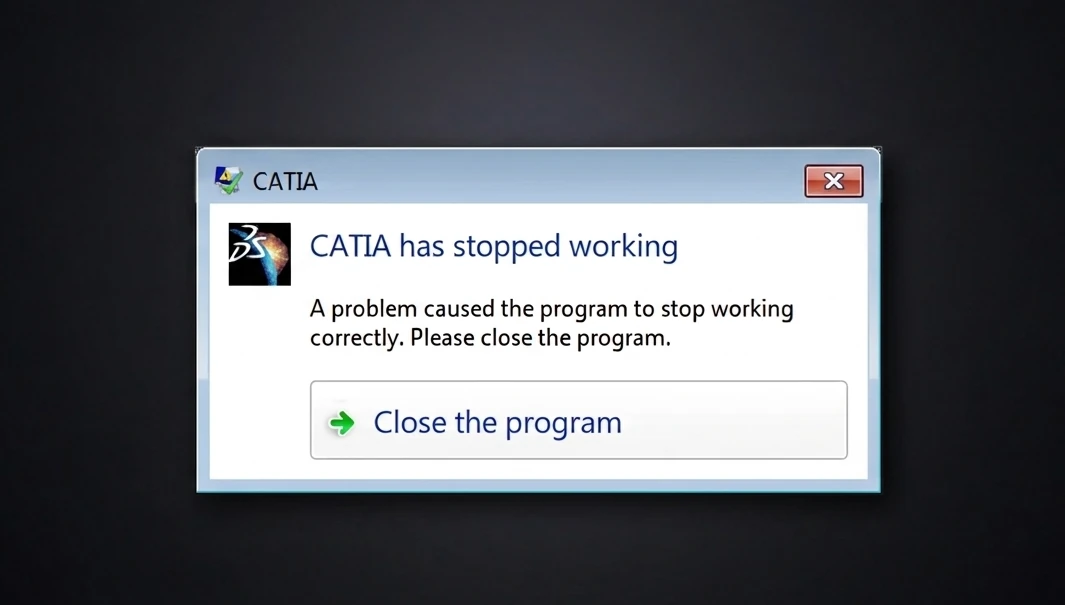
I have watched a single parameter change cascade into a wall of update errors. I have seen surfaces that built cleanly on Monday refuse to rebuild on Thursday, untouched. I have rebuilt features by hand because the kernel could not. Hours and hours of design work — lost not to bad ideas, but to a geometry engine that could not hold itself together.
This is not a complaint about one piece of software. It is an observation about an entire generation of CAD kernels. They were brilliant for their time. But their fragility is now a tax on every engineer who uses them, and a ceiling on what the industry can build.
The one reason
That fragility is the one reason Kioko exists.
We did not set out to add features to an old idea. We set out to remove the single failure that has cost the engineering world more time than any other: geometric instability. A model, once created, should survive any change you throw at it. That is not a luxury. It is the precondition for a repeatable, automatable, trustworthy design process.
So we built a new CAD kernel from the ground up, with geometric stability as the non-negotiable foundation.
How we make geometry that holds
Three commitments make this possible.
A G1 NURBS-based approach. Rather than inheriting the brittle topological assumptions of legacy kernels, we built on a class of G1-continuous, NURBS-based surfaces. The mathematics is chosen so that geometry stays well-defined under change — surfaces remain continuous and predictable where legacy kernels break.
A Rust production-ready mentality. We wrote the kernel in Rust, and we mean the full discipline that comes with it — memory safety, fearless concurrency, and a refusal to ship code that the compiler cannot prove sound. The "production-ready" mindset is not a slogan; it is the default state every commit has to meet.
100% atomic, thread-safe, end-to-end testing. Our CTO's philosophy is uncompromising: every operation is atomic and thread-safe, and the system is tested end to end, not in fragments. When robustness is the product, testing is not a phase you do at the end — it is the architecture itself.
A foundation for the next frontier in AI
This robustness is not only about saving engineers from lost afternoons. It has become a primary requirement for the training and development of world models — the physics-aware AI systems now widely regarded as the next frontier in artificial intelligence. These models learn from vast volumes of geometry and simulation data, and that data is only as trustworthy as the kernel that produces it. A fragile kernel yields inconsistent, unreproducible geometry — exactly the noise that poisons training. A kernel that holds, that returns the same well-defined geometry under every change, is the dependable foundation those models need. The robustness we built for human engineers turns out to be the same robustness machines require to learn from the physical world.
Why it matters
Robustness is not a feature engineers notice when it works. It is the absence of the lost afternoons, the rebuilt features, the cryptic update errors. It is the difference between a model you can iterate on a hundred times and a model you are afraid to touch.
Twenty years told me what the problem was. Kioko is our answer to it.
If you would like to see what a stable kernel feels like, write to us at contact@kioko.io.